Monday, 23 January 2017

PLANNING: OUR FILM OPENING CREDITS

My Film Opening Credits

Distributors

The distributor's name and logo is likely to appear first in a film opening. Distribution is the launching and sustaining films in the market place .
Uk film distributors spend £300 million a year alone just bringing new releases to market and building awareness and interest among audiences.
Social media is one of the most widely used platforms by distributors to spread their films around and make their audience aware of its existence. The social media platforms that are used are free so they don't contribute to the overall costs of the film.

Opening Credits

opening credits (the title sequence) list is the most important members of the production, such as actors, original novelist, casting director, composer, director of photography, screenwriter and director.

Our opening credits List

1. Studio that is distributing the film: Verve
2. Production company: A Metropolitan Film 3. Main artistic credit: A (name) film; A film by Alastair Simpson 4. Starring: Calum Gethin-Barkway 5. Film Title: Contradiction
6. Featuring Callum Drewett and Oliver Roberts   7. Casting by Alastair Simpson 8. Music by Alastair Simpson Music
9.Edited by Alastair Simpson and Calum Gethin-Barkway
11. Director of Photography Callum Drewett  
13.Written by Callum Drewett and Oliver Roberts screenplay by Callum Drewett and Oliver  Roberts
14. Directed by Alastair Simpson


Monday, 9 January 2017

PLANNING:PADLET

Today our group created a Padlet, which is an online group organisation chalkboard tool so we can share and contribute to ideas.

Monday, 5 December 2016

RESEARCH: BRITISH INDEPENDENT FILM AWARDS

British Independent Film Awards (BIFA)


I have been following with interest, the british independent film awards because I wanted to know how the film 'American honey' performed as we were introduced to the fim as a UK independent film when we went on BFI independent study day. It was not immediately successful as there was no big names excepting Shia Labeouf who played the character Jake. I find this film interesting as it is an independent British film which is what I will be making for my A-level Media.


I learned that American Honey is a British independent film because of the British director, contributing parties and key organisations. Andrea Arnold is known for making the film Fishtank which has a budget of only £1.3 million, compare this with Star Wars The Force Awakens which had a budget of £203 million. American Honey is an example of a BFI/ Film4 funding.

Another film that was successful was I, Daniel Blake, this is one of the more significant films due to it addressing very real and current issues within less fortunate societies in the UK. This is called social realism. The director Ken Loach, is known for, within his films, addressing very real and possible relatable issues within our society and that are going on in our country, especially ones that are not necessarily reported on in the news or in other films. Ken Loach is also known for talking out against other British directors for going for the safe options.

Tuesday, 29 November 2016

PLANNING: Interviewing our character


Open Source here.


We have decided to interview our characters to get to know them. This screenshot from the website 'Film Escape' has an article from Charlie Sierra who writes about 'Pen Densham' who is an Oscar nominated film maker who has made 16 feature films. He uses the technique of interviewing characters to allow him to get to know the characters better. 

We will interview the policeman after the incident where he hits the teenager on the bike. We will ask him about the family situation and how much pressure he is under during his work.

Here is the interview:

Psychiatrist: Hello, how are you?
Police Officer: Not bad, I’m pretty good thank you.
Psychiatrist: So, have you been alright recently… has there been anything on your mind at all and still there now?
Police Officer: I’ve just been under a lot of pressure recently.
Psychiatrist: From work?
Police Officer: Mainly from work, but also from home I guess.
Psychiatrist: What’s been happening at work that’s causing you to stress?
Police Officer: I am failing to meet deadlines, my boss is angry, the work is piling and don’t get much time at home for my family.
Psychiatrist: Ok, do you think this has affected you mentally, like do you think it has influenced the accident that happened earlier this week.
Police Officer: What accident? There wasn’t one that involved me.
Psychiatrist: I want you to be honest with me now because I am suspicious of the way you are acting. (Squints eyes)
Police Officer: Okay, yes there was… but it wasn’t anything major I promise. (Rubbing his hands acting aggravated in his chair)
Psychiatrist: Ah, I see. So I am right in saying that there was an accident on your terms and yours only?
Police Officer: Unfortunately yes. (Looks down to his feet)

Psychiatrist: Right… Here is how I’m going to help (places hand on the file of paper before fading black into a cut away shot)

Wednesday, 23 November 2016

PLANNING: THE TOP LINE & THE BIG QUESTION

I watched a video on Frank Ash who is the creative consultant for BBC Films, who has taught storytelling and creative techniques to people and film crews across the BBC and beyond. 


THE TOP LINE: The story is about police discrimination towards adolescents, who are placed into police custody. However one day the tables turn... The policeman hits a adolescent and he happens to be related to the two discriminated adolescents that are put in police custody. The next day the two adolescent people confront the policeman, they are now in control. 

THE BIG QUESTION: What will happen to the policeman? Will justice prevail?

TREATMENT: set at local bakery, inside the assistant is serving cupcakes. set then outside, boys in a huddle, unwrap the cupcake and the policeman then comes in and sees them behaving 'mischievously'. The teenagers exchange glances and then see the policeman and run. policeman asks what they were doing hailing after them. 
cut to teenagers being released and greeted by a friend who is wearing a hat. Cut to scene were policeman takes phone call from superior.
Cut to scene in which policeman is driving home from work and then boy gets hit. Policeman takes shoulder from boy with hat and rolls him over and displays face of boy.

Friday, 18 November 2016

Audiences Piktochart

Loading...
Loading...

RESEARCH: Business of Film


1.3 - What is the cultural value of film?


The cultural value of film
In  the UK, the BFI (British Film Institute), and its predecessor the UK Film Council, have published a number of reports on the economic and cultural value of film.Why film matters to the economySo all is well for film in the UK?Yes and no. Americans take most of the money at the box office. UK independent films took only 16% of the UK box office takings on 2014. There's no large British film production or distribution company based in the UK. Digital technology makes it possible for large global online firms to distribute worldwide, and again, most of these companies - Netflix, Amazon, iTunes/Apple - are US-based.The benefits of inward investmentThinking about the value chainThe film business value chain


The UK spend of domestic UK films (the green line) has been reasonably constant over this period. The UK makes many independent films that are identifiably British, such as Paddington, The Inbetweeners, The Imitation Game, Mr. Turner, Pride and Philomena.Many of these films perform well at awards time obtaining BAFTAs and even US Academy awards. This is, naturally, a source of pride for the UK, and is one of the reasons that there are so many Hollywood stars that are British.Another increasingly important aspect of film and screen production is tourism. Film tourism – visiting a place that features in a film or television programme – is more and more popular. Approximately £840 million of tourism spending by overseas visitors can be attributed to film-induced tourism.

Its also worth bearing in mind the fragile balance between culture and industry components or film The industry has a strong reliance on public funding, there is also a weak relation between the quality of a film and the price of a ticket.
Film is often regarded as a driver of the other creative industries, in that it is high profile and often makes use of the highest design and creative skills. In the UK, film was the first creative industry to be supported by film incentives in recognition of its importance. Now fiscal incentives are available for high-value television, animation, games and for certain theatre productions.
Films need to achieve critical mass to be profitable (Blockbusters) and to offset the costs of less lucrative productions. there are always risks with making movies and one way of dealing with risks is spreading out fixed costs across larger international markets.
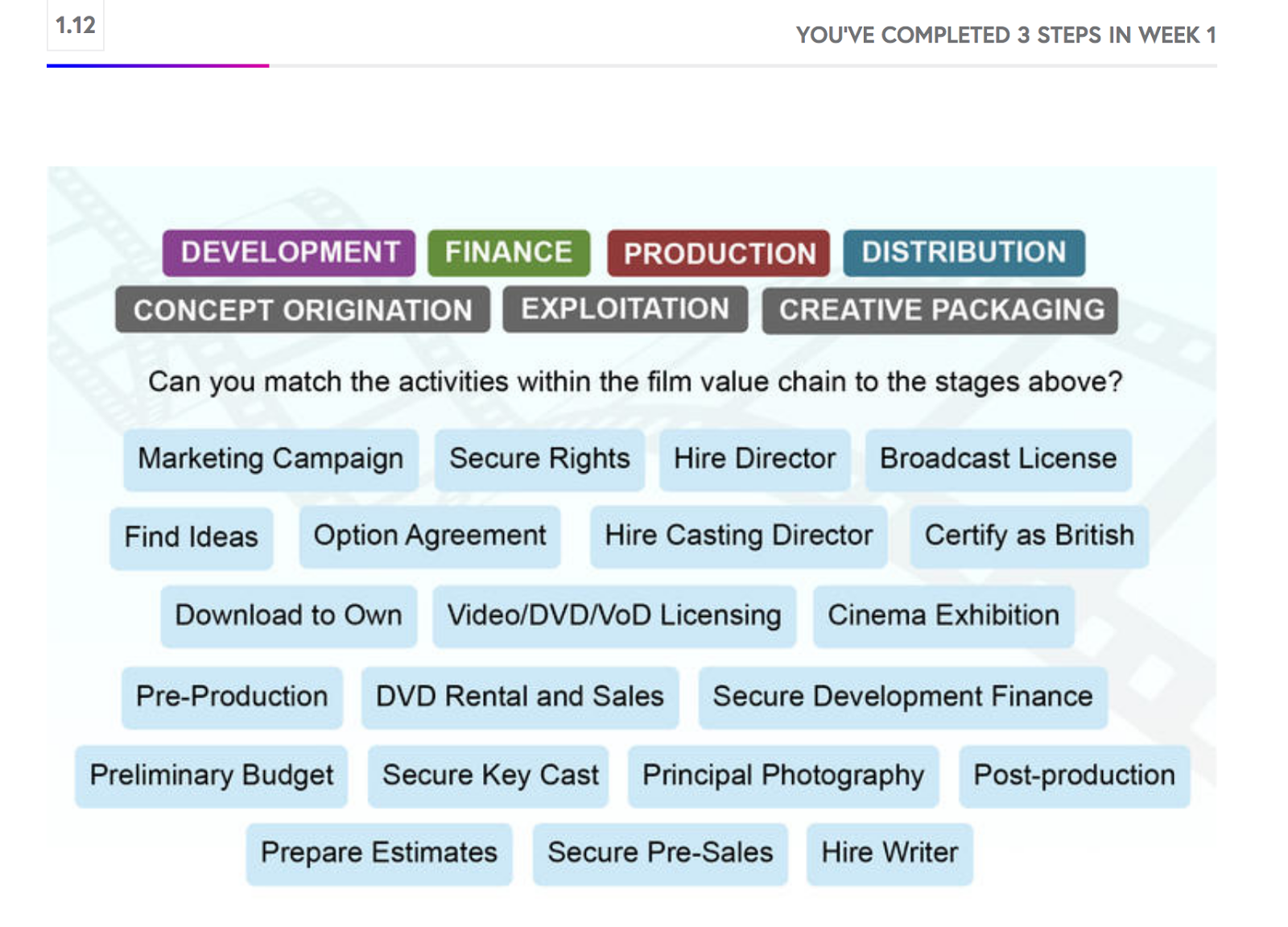
1.12 - What happens along the value chain


1.6 - Why film matters to the economy


This is a graph showing the amount of money spent in the UK on the production of feature films over the last 20 years.


1.8 - The benefits of inward investment


There is a lot of investment in film production in the UK, but a lot of it is coming from outside the UK, so as studios coming in making films like Star Wars or The Avengers here.
All of the studios, and a lot of the visual effects companies who are basically being funded through their work with the studios, pass on quite a lot of those benefits to independent producers and lower budget filmmaking at a lower cost as well. They also have a very healthy funding system which is better than most countries as they get money through the tax relief, through ourselves and through the money that gets put into film through the lottery. Their films also tend to travel well due to the fact that they have two broadcasters who invest heavily in film productions.
They train up filmmakers, producers, on screen talent, cast, who move quite comfortably between independent and studio filmmaking, and who also mave between the UK filmmaking and international filmmaking. A lot of actors, technicians, filmmakers, whether they are British or American films are British.
There are two other important public service organisations that provide much of the support to British independent film-making. They are BBC Films, the film are of the BBC and Film4 and the film arm of Channel 4.

1.10 & 1.11 - Thinking about the value chain & The film business value chain

There are seven main stages of the film value chain; Distribution, Concept Origination, Development, Finance, Creative Packaging, Production and Exploitation. Not all these stages take place for all films. In general, the film producer is the one film maker that accompanies the film on its entire journey through the value chain until it's safely in the hands of the distributors. 


Development is where effort goes into the film idea and script, right before the project 'goes to market' to be financed.

Finance: Each film is financed on its own terms and in its own way. Major studios are able to apply their own funds or secure long-term investment for film funding, so the finance process is not such a concern for them, but in the world of independent film, finance is the most difficult stage.

Pre-pre-production: The pre-pre-production refers to a very difficult stage in the life of some films that are working under tight timeframes.
The film is not yet officially financed, but money needs to be spent in order to secure key cast and crew, and start to find locations. This stage is highly risky as the film might collapse at the last minute.

Production is in some ways the most simple part of the chain. It is divided into pre-production, the official 'prep' period, principal photography, when the camera is rolling, and post production when the editing and sound and visual effects and music aspects are incorporated.

Distribution is the process of getting the film into the hands of the theatre chains, broadcasters, video stores and video on demand operators. In general a producer uses a sales agent to licence a film to distributors outside the producer's own country.

Exploitation is the process by which consumers actually experience the film. The most important and first exploitation market is the cinema and the companies that run cinemas and cinema chains are called exhibitors. Films are more and more being consumed in different ways with the growing importance of digital technologies.


When it comes to public expenditure or assistance in the arena of arts and culture, including film, policy-makers need to be able to measure and articulate the ‘value’ of their intervention.David Throsby is an economist with specialist interests in the economics of the arts and culture.The diagram above reflects his attempt to make sense of this debate.He bases his point of view on a definition of value that encompasses cultural value (Throsby, 2001).In the UK, the BFI (British Film Institute), and its predecessor the UK Film Council, have published a number of reports on the economic and cultural value of film.The most recent report on economic impact found that film contributed £3.67 billion to the UK economy.Studies on the cultural impact of film have shown how films, apart from being popular leisure activities, carry powerful personal and political messages for viewers, give new insights into other cultures, and help reflect our own cultural identity back to ourselves.If you want to read more from the BFI about this or to consider in more detail why governments, any government, might want to support film and similar creative endeavours, links are provided below.